Followers

Total Pageviews

Showing posts with label comedy. Show all posts

Sunday, November 30, 2025

Wonderland Burlesque's Down The Rabbit Hole: Flip The Frog Part 5 of 5

Wonderland Burlesque's 
Down The Rabbit Hole: 
Flip The Frog
Part 5 of 5

Down The Rabbit Hole merely places a spotlight on something slightly unusual that's caught my interest. With the help of Wikipedia, YouTube, and other sites, I gather information and learn something new.

Today, we take a final look at the Depression era cartoon, Flip the Frog.

--- ---

From Wikipedia and other sources:

Flip the Frog is an animated cartoon character created by American animator Ub Iwerks. He starred in a series of cartoons (38 total) produced by Celebrity Pictures and distributed by Metro-Goldwyn-Mayer from 1930 to 1933.

Ub Iwerks was an animator for the Walt Disney Studios and a personal friend of Walt Disney. In 1930, after a series of disputes between the two, Iwerks left Disney and went on to accept an offer from Pat Powers to open a cartoon studio of his own, Iwerks Studio Iwerks was to produce new cartoons under Powers' Celebrity Pictures auspices and distributed by Metro-Goldwyn-Mayer. The first series he was to produce was to feature a character called Tony the Frog, but Iwerks disliked the name and was subsequently changed to Flip.

Ub Iwerks planned to release the series in both color and black and white versions through Celebrity Productions, Inc. The series attracted public attention in England by being the first color sound cartoon series. After four shorts had been produced MGM picked up the series. MGM decided to produce the series entirely in black and white, releasing the ones produced in color in black and white versions only.

After the first two cartoons, the appearance of Flip the Frog gradually became less froglike. This was done with the encouragement of MGM, who thought that the series would sell better if the character were more humanized. Flip's major redesign is attributed to Grim Natwick, who made a name for himself at the Fleischer Studios with the creation of Betty Boop. Natwick also had a hand in changing Flip's girlfriend. In earlier films, she was consistently a cat, but Natwick made Flip's new girlfriend, Fifi, a human who shared distinct similarities with Betty Boop. The series had a number of recurring characters, including Flip's dog, the mule Orace, and a dizzy neighborhood spinster.

The frog's personality also began to develop. As the series progressed, Flip became more of a down-and-out, Chaplin-esque character dealing with everyday conflicts in poverty-stricken atmosphere of the Great Depression. The shorts also became increasingly risqué due to an influx of animators from New York City.

By the autumn of 1933, Flip the Frog had worn out his welcome at MGM. His final short was Soda Squirt, released in August 1933. Subsequently, Iwerks replaced the series with a new one starring an imaginative child named Willie Whopper.

Here are the last eight cartoons.

--- ----

Funny Face
(1932)

Coo Coo The Magician
(1933)

Flip's Lunch Room
(1933)

Techno-Cracked 
(1933)

Bulloney
(1933)

Chinaman's Chance
(1933)

Pale Face
(1933)

Soda Squirt
(1933)


--- ---

Sunday, November 23, 2025

Wonderland Burlesque's Down The Rabbit Hole: Flip The Frog Part 4 of 5

Wonderland Burlesque's 
Down The Rabbit Hole: 
Flip The Frog
Part 4 of 5

Down The Rabbit Hole merely places a spotlight on something slightly unusual that's caught my interest. With the help of Wikipedia, YouTube, and other sites, I gather information and learn something new.

Today, we take another look at the Depression era cartoon, Flip the Frog.

--- ---

From Wikipedia and other sources:

Flip the Frog is an animated cartoon character created by American animator Ub Iwerks. He starred in a series of cartoons (38 total) produced by Celebrity Pictures and distributed by Metro-Goldwyn-Mayer from 1930 to 1933.

Ub Iwerks was an animator for the Walt Disney Studios and a personal friend of Walt Disney. In 1930, after a series of disputes between the two, Iwerks left Disney and went on to accept an offer from Pat Powers to open a cartoon studio of his own, Iwerks Studio Iwerks was to produce new cartoons under Powers' Celebrity Pictures auspices and distributed by Metro-Goldwyn-Mayer. The first series he was to produce was to feature a character called Tony the Frog, but Iwerks disliked the name and was subsequently changed to Flip.

Ub Iwerks planned to release the series in both color and black and white versions through Celebrity Productions, Inc. The series attracted public attention in England by being the first color sound cartoon series. After four shorts had been produced MGM picked up the series. MGM decided to produce the series entirely in black and white, releasing the ones produced in color in black and white versions only.

After the first two cartoons, the appearance of Flip the Frog gradually became less froglike. This was done with the encouragement of MGM, who thought that the series would sell better if the character were more humanized. Flip's major redesign is attributed to Grim Natwick, who made a name for himself at the Fleischer Studios with the creation of Betty Boop. Natwick also had a hand in changing Flip's girlfriend. In earlier films, she was consistently a cat, but Natwick made Flip's new girlfriend, Fifi, a human who shared distinct similarities with Betty Boop. The series had a number of recurring characters, including Flip's dog, the mule Orace, and a dizzy neighborhood spinster.

The frog's personality also began to develop. As the series progressed, Flip became more of a down-and-out, Chaplin-esque character dealing with everyday conflicts in poverty-stricken atmosphere of the Great Depression. The shorts also became increasingly risqué due to an influx of animators from New York City.

By the autumn of 1933, Flip the Frog had worn out his welcome at MGM. His final short was Soda Squirt, released in August 1933. Subsequently, Iwerks replaced the series with a new one starring an imaginative child named Willie Whopper.

Here are the next eight cartoons.

--- ----

Office Boy
(1932

Room Runners
(1932)

Stormy Seas
(1932)

Circus
(1932)

The Goal Rush
(1932)

The Phoney Express
(1932)

 Music Lesson
(1932)

Nurse Maid
(1932)


--- ---

Sunday, November 16, 2025

Wonderland Burlesque's Down The Rabbit Hole: Flip The Frog - Part 3 of 5

Wonderland Burlesque's 
Down The Rabbit Hole: 
Flip The Frog
Part 3 of 5

Down The Rabbit Hole merely places a spotlight on something slightly unusual that's caught my interest. With the help of Wikipedia, YouTube, and other sites, I gather information and learn something new.

Today, we take another look at the Depression era cartoon, Flip the Frog.

--- ---

From Wikipedia and other sources:

Flip the Frog is an animated cartoon character created by American animator Ub Iwerks. He starred in a series of cartoons (38 total) produced by Celebrity Pictures and distributed by Metro-Goldwyn-Mayer from 1930 to 1933.

Ub Iwerks was an animator for the Walt Disney Studios and a personal friend of Walt Disney. In 1930, after a series of disputes between the two, Iwerks left Disney and went on to accept an offer from Pat Powers to open a cartoon studio of his own, Iwerks Studio Iwerks was to produce new cartoons under Powers' Celebrity Pictures auspices and distributed by Metro-Goldwyn-Mayer. The first series he was to produce was to feature a character called Tony the Frog, but Iwerks disliked the name and was subsequently changed to Flip.

Ub Iwerks planned to release the series in both color and black and white versions through Celebrity Productions, Inc. The series attracted public attention in England by being the first color sound cartoon series. After four shorts had been produced MGM picked up the series. MGM decided to produce the series entirely in black and white, releasing the ones produced in color in black and white versions only.

After the first two cartoons, the appearance of Flip the Frog gradually became less froglike. This was done with the encouragement of MGM, who thought that the series would sell better if the character were more humanized. Flip's major redesign is attributed to Grim Natwick, who made a name for himself at the Fleischer Studios with the creation of Betty Boop. Natwick also had a hand in changing Flip's girlfriend. In earlier films, she was consistently a cat, but Natwick made Flip's new girlfriend, Fifi, a human who shared distinct similarities with Betty Boop. The series had a number of recurring characters, including Flip's dog, the mule Orace, and a dizzy neighborhood spinster.

The frog's personality also began to develop. As the series progressed, Flip became more of a down-and-out, Chaplin-esque character dealing with everyday conflicts in poverty-stricken atmosphere of the Great Depression. The shorts also became increasingly risqué due to an influx of animators from New York City.

By the autumn of 1933, Flip the Frog had worn out his welcome at MGM. His final short was Soda Squirt, released in August 1933. Subsequently, Iwerks replaced the series with a new one starring an imaginative child named Willie Whopper.

Here are the next eight cartoons.

--- ----

Africa Squeaks
(1931)

Spooks
(1931)

The Milkman
(1932)

Fire-Fire
(1932)

What A Life
(1932)

Puppy Love
(1932)

School Days
(1932)

The Bully
(1932)


--- ---

Sunday, November 09, 2025

Wonderland Burlesque's Down The Rabbit Hole: Flip The Frog - Part 2 of 5

Wonderland Burlesque's 
Down The Rabbit Hole: 
Flip The Frog
Part 2 of 5

Down The Rabbit Hole merely places a spotlight on something slightly unusual that's caught my interest. With the help of Wikipedia, YouTube, and other sites, I gather information and learn something new.

Today, we take another look at the Depression era cartoon, Flip the Frog.

--- ---

From Wikipedia and other sources:

Flip the Frog is an animated cartoon character created by American animator Ub Iwerks. He starred in a series of cartoons (38 total) produced by Celebrity Pictures and distributed by Metro-Goldwyn-Mayer from 1930 to 1933.

Ub Iwerks was an animator for the Walt Disney Studios and a personal friend of Walt Disney. In 1930, after a series of disputes between the two, Iwerks left Disney and went on to accept an offer from Pat Powers to open a cartoon studio of his own, Iwerks Studio Iwerks was to produce new cartoons under Powers' Celebrity Pictures auspices and distributed by Metro-Goldwyn-Mayer. The first series he was to produce was to feature a character called Tony the Frog, but Iwerks disliked the name and was subsequently changed to Flip.

Ub Iwerks planned to release the series in both color and black and white versions through Celebrity Productions, Inc. The series attracted public attention in England by being the first color sound cartoon series. After four shorts had been produced MGM picked up the series. MGM decided to produce the series entirely in black and white, releasing the ones produced in color in black and white versions only.

After the first two cartoons, the appearance of Flip the Frog gradually became less froglike. This was done with the encouragement of MGM, who thought that the series would sell better if the character were more humanized. Flip's major redesign is attributed to Grim Natwick, who made a name for himself at the Fleischer Studios with the creation of Betty Boop. Natwick also had a hand in changing Flip's girlfriend. In earlier films, she was consistently a cat, but Natwick made Flip's new girlfriend, Fifi, a human who shared distinct similarities with Betty Boop. The series had a number of recurring characters, including Flip's dog, the mule Orace, and a dizzy neighborhood spinster.

The frog's personality also began to develop. As the series progressed, Flip became more of a down-and-out, Chaplin-esque character dealing with everyday conflicts in poverty-stricken atmosphere of the Great Depression. The shorts also became increasingly risqué due to an influx of animators from New York City.

By the autumn of 1933, Flip the Frog had worn out his welcome at MGM. His final short was Soda Squirt, released in August 1933. Subsequently, Iwerks replaced the series with a new one starring an imaginative child named Willie Whopper.

Here are the next seven cartoons.

--- ----

The Soup Song
(1931)

Laughing Gas
(1931)

Ragtime Rodeo
(1931)

The New Car
(1931)

Movie Mad
(1931)

The Village Specialist
(1931)

Jail Bird
(1931)


--- ---

Sunday, November 02, 2025

Wonderland Burlesque's Down The Rabbit Hole: Flip The Frog - Part 1 of 5

Wonderland Burlesque's 
Down The Rabbit Hole: 
Flip The Frog
Part 1 of 5

Down The Rabbit Hole merely places a spotlight on something slightly unusual that's caught my interest. With the help of Wikipedia, YouTube, and other sites, I gather information and learn something new.

Today, we take a look at the Depression era cartoon, Flip the Frog.

--- ---

From Wikipedia and other sources:

Flip the Frog is an animated cartoon character created by American animator Ub Iwerks. He starred in a series of cartoons (38 total) produced by Celebrity Pictures and distributed by Metro-Goldwyn-Mayer from 1930 to 1933.

Ub Iwerks was an animator for the Walt Disney Studios and a personal friend of Walt Disney. In 1930, after a series of disputes between the two, Iwerks left Disney and went on to accept an offer from Pat Powers to open a cartoon studio of his own, Iwerks Studio Iwerks was to produce new cartoons under Powers' Celebrity Pictures auspices and distributed by Metro-Goldwyn-Mayer. The first series he was to produce was to feature a character called Tony the Frog, but Iwerks disliked the name and was subsequently changed to Flip.

Ub Iwerks planned to release the series in both color and black and white versions through Celebrity Productions, Inc. The series attracted public attention in England by being the first color sound cartoon series. After four shorts had been produced MGM picked up the series. MGM decided to produce the series entirely in black and white, releasing the ones produced in color in black and white versions only.

After the first two cartoons, the appearance of Flip the Frog gradually became less froglike. This was done with the encouragement of MGM, who thought that the series would sell better if the character were more humanized. Flip's major redesign is attributed to Grim Natwick, who made a name for himself at the Fleischer Studios with the creation of Betty Boop. Natwick also had a hand in changing Flip's girlfriend. In earlier films, she was consistently a cat, but Natwick made Flip's new girlfriend, Fifi, a human who shared distinct similarities with Betty Boop. The series had a number of recurring characters, including Flip's dog, the mule Orace, and a dizzy neighborhood spinster.

The frog's personality also began to develop. As the series progressed, Flip became more of a down-and-out, Chaplin-esque character dealing with everyday conflicts in poverty-stricken atmosphere of the Great Depression. The shorts also became increasingly risqué due to an influx of animators from New York City.

By the autumn of 1933, Flip the Frog had worn out his welcome at MGM. His final short was Soda Squirt, released in August 1933. Subsequently, Iwerks replaced the series with a new one starring an imaginative child named Willie Whopper.

Here are the first seven cartoons.

--- ----

Fiddlesticks
(1930)

Flying Fists
(1930)

Little Orphan Willie
(1930)

Puddle Pranks
(1930)

The Village Barber
(1930)

The Cuckoo Murder Case
(1930)


The Village Smithy
(1931)

Next time: More fun with Flip the Frog!

--- ---

Sunday, October 19, 2025

Wonderland Burlesque's Down The Rabbit Hole: Pooch The Pup - Part II

Wonderland Burlesque's
Down The Rabbit Hole: 
Pooch The Pup
Part II

Down The Rabbit Hole merely places a spotlight on something slightly unusual that's caught my interest. With the help of Wikipedia, YouTube, and other sites, I gather information and learn something new.


Today, we take a final look at the animated output of one Pooch the Pup.  

--- ---

From Wikipedia and other sources:

Pooch the Pup is a cartoon dog, appearing in Walter Lantz cartoons during the studio's black-and-white era. The character appeared in 13 shorts made in 1932 and 1933.

In 1931, Walter Lantz was encountering slight financial troubles. One way to cope with the problems was to conceive a new series of cartoons featuring a new character, thus leading to the appearance of Pooch the Pup. While Lantz was busy directing the Pooch the Pup shorts, his colleague Bill Nolan  focused on the long-running Oswald the Lucky Rabbit cartoons.

In 1933, Pooch the Pup made his final appearance - in a parody of Mae West's film, She Did Him Wrong. Following his retirement from the screen, Oswald the Rabbit was seen in two cartoons wearing a jacket similar to Pooch's. It suggests that the two Oswald shorts were initially designed to feature Pooch.

We looked at the first six cartoons last week. Here are the remaining seven cartoons.

--- ---

The Terrible Troubadour
 (January 30, 1933)

The Lumber Champ 
(March 13, 1933)

Nature's Workshop 
(June 5, 1933)

Pin Feathers 
(July 3, 1933)

Hot and Cold 
(August 14, 1933)

King Klunk 
(September 4, 1933)

She Done Him Right 
(October 9, 1933)

Pooch The Pup w/ creator Walter Lantz

Sunday, October 12, 2025

Wonderland Burlesque's Down The Rabbit Hole: Pooch The Pup - Part I

Wonderland Burlesque's
Down The Rabbit Hole: 
Pooch The Pup
Part I

Down The Rabbit Hole merely places a spotlight on something slightly unusual that's caught my interest. With the help of Wikipedia, YouTube, and other sites, I gather information and learn something new.

Today, we take a first look at the animated output of one Pooch the Pup.  

--- ---

From Wikipedia and other sources:

Pooch the Pup is a cartoon dog, appearing in Walter Lantz cartoons during the studio's black-and-white era. The character appeared in 13 shorts made in 1932 and 1933.

In 1931, Walter Lantz was encountering slight financial troubles. One way to cope with the problems was to conceive a new series of cartoons featuring a new character, thus leading to the appearance of Pooch the Pup. While Lantz was busy directing the Pooch the Pup shorts, his colleague Bill Nolan  focused on the long-running Oswald the Lucky Rabbit cartoons.

In 1933, Pooch the Pup made his final appearance, in a parody of Mae West's film, She Done Him Wrong. Following his retirement from the screen, Oswald the Rabbit was seen in two cartoons wearing a jacket similar to Pooch's. It suggests that the two Oswald shorts were initially designed to feature Pooch.

Here are the first six cartoons.

--- ---

The Athlete
(August 29, 1932)

The Butcher Boy 
(September 26, 1932)

The Crowd Snores 
(October 24, 1932)

The Under Dog 
(November 7, 1932)

Cats and Dogs 
(December 5, 1932)

Merry Dog 
(January 2, 1933)

Pooch The Pup w/ creator Walter Lantz

Sunday, April 13, 2025

Wonderland Burlesque's Down The Rabbit Hole: The Alice Comedies - Part Five

Wonderland Burlesque's
Down The Rabbit Hole:
The Alice Comedies
Part Five

Down The Rabbit Hole merely places a spotlight on something slightly unusual that's caught my interest. With the help of Wikipedia, YouTube, and other sites, I gather information and learn something new.

Today, we take a look at more Walt Disney's The Alice Comedies!

--- ---

The Alice Comedies are a series of live-action animated shorts created by Walt Disney in the 1920s, in which a live-action little girl named Alice (originally played by Virginia Davis) and an animated cat named Julius have adventures in an animated landscape. The shorts were the first work by what ultimately became The Walt Disney Company.

Disney, Ub Iwerks, and their staff at the failing Laugh-O-Gram Studio in Kansas City, Missouri, made the first Alice Comedy, a one-reel 1923 short subject titled Alice's Wonderland. After completing the film, the studio went bankrupt and was forced to shut down. After raising money by working as a freelance photographer, Disney bought a one-way train ticket to Los Angeles, California to live with his uncle Robert and his brother Roy. 

In California, Disney continued to send out proposals for the Alice series, in hopes of obtaining a distribution agreement. A deal was finally arranged through Winkler Pictures, run by Margaret Winkler and her fiancé, Charles Mintz. Due to a recent falling out with Pat Sullivan, the studio needed a quick replacement for their centerpiece Felix the Cat animated series. Disney convinced Virginia Davis's family to bring her from Missouri to Los Angeles to star in the series.

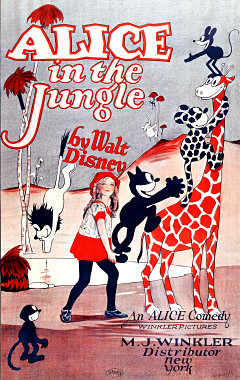
Disney both directed and produced all 57 films in this series. Over the course of the series, four actresses played Alice: Virginia Davis (15), Margie Gay (31), Dawn O'Day (1) and Lois Hardwick (10). The film Alice in the Jungle contains only archival footage of Virginia Davis.

The shorts in this series are now all in the public domain in the United States.

About Virginia Davis:

Virginia Davis was an American child actress in films. She is best known for working with Walt Disney and Ub Iwerks on the animated short series Alice Comedies. Over the next 20 years, she went on to work at other Hollywood studios as a child actress and, later, as a supporting actress.

Recalling her work on the Alice Comedies, Davis said, "It was a great time – full of fun, adventure, and 'let's pretend.' I adored and idolized Walt, as any child would. He would direct me in a large manner with great sweeping gestures. One of my favorite pictures was Alice's Wild West Show. I was always the kid with the curls, but I was really a tomboy, and that picture allowed me to act tough. I took great joy in that."

About Ub Iwerks:

Ubbe Ert Iwerks, known as Ub Iwerks, was an American animator, cartoonist, character designer, inventor, and special effects technician, known for his work with Walt Disney Animation Studios in general, and for having worked on the development of the design of the character of Mickey Mouse, among others. Disney and Iwerks ventured into animation together. Iwerks joined Disney as chief animator on the Laugh-O-Gram shorts series beginning in 1922. Iwerks would spend most of his career with Disney. The first few Mickey Mouse and Silly Symphony cartoons were animated almost entirely by Iwerks,

Iwerks quickly felt he was not getting the credit he deserved for drawing all of Disney's successful cartoons. Eventually, Iwerks and Disney had a falling out; their friendship and working partnership were severed in January 1930. According to an unconfirmed account, a child approached Disney and Iwerks at a party and asked for a picture of Mickey to be drawn on a napkin, to which Disney handed the pen and paper to Iwerks and stated, "Draw it." Iwerks became furious and threw the pen and paper, storming out. Iwerks accepted a contract with Disney's former distributor, Pat Powers (with whom Disney also had a falling out) to leave Disney and start an animation studio under his own name. The Iwerks Studio was never a major commercial success and though he did help develop Chuck Jones as a talent. Iwerks eventually returned to Disney and contributed to the success of such classics as Sound Of The South (1946) and 101 Dalmatians (1961), as well as the design of some of the theme park attractions.

Outside of Disney, he is responsible for the birds in Alfred Hitchcock's The Birds (1963). He also contributed the animation sequences in Mary Poppins (1964).

About Dawn O'Day:

Dawn O'Day, who is better known as Anne Shirley, only appears in one Alice Comedy: Alice's Egg Plant. It was her film debut. As child star Dawn O'Day, she appeared in a number of motion pictures. However, in 1934, Shirley starred as the character of Anne Shirley in Anne of Green Gables and took that character's name as her legal and stage name. 

As Anney Shirley, she starred in Steamboat Round the Bend, Make Way for a Lady and Stella Dallas, for which she was nominated for the Academy Award for Best Supporting Actress. Her later roles came in films such as Vigil in the Night, Anne of Windy Poplars, The Devil and Daniel Webster and Murder, My Sweet, her final film. She retired from the screen in 1945.

About Margie Gay:

Margie Gay (Marjorie Teresa Gossett) was an American actress. She was the third actress to play Alice in the Alice Comedies. Margie was born in Muskogee, Oklahoma. She was married to Dan Lowell Gardner. And, from what I could see on the internet, very little else is known about her.

--- ---

I'd never heard of these before. And, I must say, they strike me as a little strange. Some of the humor certainly suffers in these more empathetic days. But it is interesting to see where it all began. Here's the next five. 

Alice's Tin Pony - 1925
Alice Comedy #21
feat. Margie Gay

Alice Chops the Suey - 1925
Alice Comedy #22
feat. Margie Gay

Alice the Jail Bird - 1925
Alice Comedy #23
feat. Margie Gay

(Presumed Lost)
Alice Plays Cupid - 1925
Alice Comedy #24
feat. Margie Gay

Alice Rattled by Rats - 1925
Alice Comedy #25
feat. Margie Gay

Alice in the Jungle - 1925
Alice Comedy #26
feat. Virginia Davis

--- ---


--- ---

That's all for now.

Next week: five more great vintage Alice Comedies!

--- ---

Sunday, December 29, 2024

Wonderland Burlesque's Down The Rabbit Hole: The Ronny Howard Show

Wonderland Burlesque's
Down The Rabbit Hole: 
The Ronny Howard Show

Down The Rabbit Hole merely places a spotlight on something slightly unusual that's caught my interest. With the help of Wikipedia, YouTube, and other sites, I gather information and learn something new.

Today, we take a look at The Ronny Howard Show.

--- --

Before directing Oscar-winning motion pictures, before Happy Days, before American Graffiti, and while he was still co-starring weekly on The Andy Griffith Show, Ron Howard appeared to also be hosting his his own variety show at the ripe old age of 11-years old! Complete with grade school hoofers ala The June Taylor Dancers, big name guest star, Danny Kaye, and pre-teen actress Donna Butterworth, The Ronny Howard Show was not exactly what it appeared to be.

Fact is, it was a show-within-a-show - a one-off segment on The Danny Kaye Show which appeared on CBS from 1963 to 1967.

By this point in his career, Howard had won America's hearts in The Music Man, a Twilight Zone episode which became a fan favorite, the film version of The Courtship Of Eddie's Father, and was well into his fifth season on The Andy Griffith Show. And, as with most things Ron Howard either appeared in or directed, his brother, Clint Howard (of Gentle Ben fame), can be spotted in as the chief during a spy spoof. Add Donna Butterworth, (who had appeared in the film Paradise-Hawaiian Style in 1966 with Elvis Presley) belting out a rousing version of Sitting On Top of the World, and it would appear you have the real deal.

The whole affair is presented in a rather canned style which positively screams 'summer-replacement' series - in other words - terribly realistic (with emphasis on 'terrible'). 

Who knows, maybe it was the network's way of telling Mr. Kaye - who had a reputation for being moody and difficult to work with - that they were looking about for his replacement? Not that such behavior was anything new to an old pro like Ronny Howard, who, having endured five seasons already, would go on to for an additional three season working opposite Frances Bavier, who played Aunt Bee. It seems Bavier was easily offended throughout the series, frequently clashed with the shows other stars, and had to be handled with kid gloves by both cast and crew. 

In any event, this is a must see to believe for any fan of the variety show format.

And, all in all, one of the oddest segments in television history. 

Enjoy!

--- ---
 
The Ronny Howard Show
(1966)

--- ---

Wednesday, December 18, 2024

Wonderland Burlesque's The Twelve Days Before Xmas - Day Six: Department Store Santa Claus - Howard Morris

Wonderland Burlesque's
The Twelve Days Before Xmas
Day Six:
Department Store Santa Claus - Howard Morris

Nothing says Xmas like a bawling brat squirming on Santa's lap at the local department store, to say nothing of all the fantastical requests old Kris Kringle gets whispered into his ear year after year.  Well, here's a little novelty record that sought to capture all the excitement of what it was like to be a... Department Store Santa Claus!

Department Store Santa Claus - Howard Morris
 (Before & After Xmas)

Department Store Santa Claus is a Christmas novelty record in two parts (Before Xmas and After Xmas) by the comic actor, director, and voice over artist. Howard Morris He was best known for his role on The Andy Griffith Show as Ernest T. Bass, and as Uncle Goopy on Sid Caesar's  celebrated comedy sketch show Your Show of Shows (1954). Released on Roulette Records as single R-4309 in 1960, it failed to chart, but remains fondly remembered by many. 

Howard Morris

We're have way there, folks. Only six more to go!