Warning... this is an adult site. If reading or viewing things about what gay men do sexually with one another bothers you - you should not read this blog. This blog is a reflection of my adventures and thoughts. Some are fun, some not so pretty. I won't name names, or kiss and tell... but I will live to tell. And baby, trust me - I am gonna spill it all over your pretty little party dress. Enjoy!
Down The Rabbit Hole merely places a spotlight on something slightly unusual that's caught my interest. With the help of Wikipedia, YouTube, and other sites, I gather information and learn something new.
Today, we take a look at the history and music of the influential Australian band The Birthday Party/The Boys Next Door.
--- ---
From Wikipedia and other sources:
The Birthday Party/The Boys Next Door were an Australian post-punk band, active from 1977 to 1983. They began life as The Boys Next Door, but then changed their name to when they headed for London in 1980. The nucleus of the band first met at the private boys school Caulfield Grammar School, in suburban Melbourne, in the early seventies. A rock group was formed in 1973, with Nick Cave (vocals), Mick Harvey (guitar), and Phill Calvert (drums), with other students filling in various roles. Most were also members of the school choir. The band played under various names at parties and school functions with a mixed repertoire of glam rock.
After their final school year in 1975 the band decided to continue as a four-piece group, with friend Tracy Pew picking up the bass. Greatly affected by the punk explosion of 1976, The Boys Next Door, as they were now called, began performing punk and proto-punk cover versions. The Boys' second guitarist, Rowland S. Howard, joined in 1978, and about this time the group's sound changed dramatically with the introduction of the use of audio feedback. Their sound drew upon punk, rockabilly, free jazz and blues, defying categorization.
In producer/engineer Tony Cohen they found a sympathetic collaborator who encouraged experimentation. In manager Keith Glass they found an enthusiastic financial backer and a record label. Glass' label Missing Link Records released all of the group's early records. The Boys Next Door's best known song, Shivers, written by Howard, and first performed and recorded by his band The Young Charlatans, was banned by radio stations because of a reference to suicide.
After numerous live gigs, recordings and having found moderate success in Australia, the group moved to London in 1980, prompting a name change. Their new environment launched a period of innovative and aggressive music-making. However, they quickly grew disillusioned with the state of the music scene in London, only finding like-minded groups in the Fall and the Pop Group.
After tours in the UK, Australia and the US, the group relocated to West Berlin in 1982. Here, their sound became noisier, with Nick Cave barely being heard above the din. Though Cave drew on earlier rock and roll shriekers such as Iggy Pop and Suicide's Alan Vega, his singing with the Birthday Party remained powerful and distinct, with his lyrics also drawing on the likes of Arthur Rimbaud and Charles Baudelaire.
Their single Release the Bats came out during the emergence of the gothic scene. The song, about "vampire sex" was promoted by an advertisement with the words "Dirtiness is next to antigodliness". The group's 1982 album Junkyard was inspired by American Southern Gothic imagery.
Then the band was rocked by several changes. Calvert was ejected from in 1982 due to his inability to "nail down the beats". Harvey then moved to drums. Then Pew was jailed for drunk driving and petty theft. He would rejoin the band in July of 1982.
After a one-off recording project with Lydia Lunch, which Cave and Harvey disavowed, the group toured in January of 1983. They soon found themselves whittled down to a four-piece. By this point, tensions between Howard and Cave had grown intense, leading to Harvey's departure from the group.
The Birthday Party played their final show at the Crystal Ballroom in St Kilda on 9 June 1983 and disbanded not long after, due in part to the split between Cave and Howard, as well as work and drug-related exhaustion.
--- ---
These Boots Are Made For Walking - The Boys Next Door
Down The Rabbit Hole merely places a spotlight on something slightly unusual that's caught my interest. With the help of Wikipedia, YouTube, and other sites, I gather information and learn something new.
Today, we take a look at the history and music of the Humpe sisters, Annette and Inga.
--- ---
From Wikipedia and other sources:
The Humpe sisters, Annette and Inga, spent their childhood in Herdecke and Bad Pyrmont. After high school and following six semesters of studying composition and piano in Cologne, Annette moved to Berlin in 1974, where she started performing in various bands. Her younger sister Inga soon followed and the sisters naturally found themselves collaborating on various musical projects.
They first achieved first commercial successes in 1979 with the band Neonbabies, founded by the sisters. The sisters released their debut album in 1981, with Inga on lead vocals.
In 1980, Annette Humpe also helped found Ideal along with Ernst Ulrich Deuker and Frank Jürgen Krüger. In the band, Annette served as a songwriter while performing lead vocals and keyboards. The group also recorded songs originally performed by Neonbabies including the highly popular Blaue Augen, which was written by Annette. That song became Ideal's highest-charting song and was also covered by various other artists.
In addition, the Ideal members were close friends of the band Trio, for whom Annette occasionally performed as a backing vocalist, most notably on the #1single Da Da Da.
When Ideal and Neonbabies both disbanded in 1983, Annette became a record producer. For the group DÖF, she co-wrote and produced the commercially successful single Codo, which was a #1 hit in Germany, Austria and the Netherlands and also reached #4 on the Swiss single charts. The song was performed by two Austrian comedians, Joesi Prokopetz and Manfred Tauchen along with Inga Humpe.
In addition, in 1984, Annette and Inga served as co-producers for the band Palais Schaumburg.
The sisters founded the duo Humpe & Humpe in 1985. They wrote and produced most of the songs released on their two studio albums. While the duo was widely known as Humpe & Humpe, their names appeared on the albums as Inga & Anete Humpe and Humpe – Humpe respectively. In the UK, the duo was known as Swimming with Sharks due to the potential sexual connotations of the name Humpe in English.
Their first album contained the single Yamaha. The song was particularly successful in Japan during 1985, and it was released with a memorable split-screen video featuring the sisters. Their second album, and English language venture, featured two singles; No Longer Friends and Careless Love. They received significant airplay on BBC Radio One during 1987 and strong reviews from British music press, although this did not result in significant Chart success for the sisters. The single Careless Love reached the German single charts and peaked at #24.
As international success remained elusive, the duo went their separate ways.
During this time Annette continued to produce other artists including Rio Reiser and Heiner Pudelko. By 1990, with Humpe & Humpe in the rear view mirror, Annette released her first solo studio album called Solo. The album failed to chart. After the release of her solo album, Annette decided she was through with singing. She would concentrate exclusively on composing and producing over the following years.
Inga returned to England, where she sang as a featured vocalist for Johnny Logan and Howard Jones. Inga's first solo album was released in 1990 under the title Planet Oz. It included the single Riding into Blue (Cowboy Song), written and produced by Trevor Horn and became a minor hit.
In 1995 Inga returned to Germany and joined her sister, performing as the duo Bamby. They released the album Wall of Sugar.
Annette went on to find success as part of the group Ich + Ich, while Inga recorded several cover songs and became a frequent featured backing vocalist on various singles. In 2000, Inga formed the electronic duo 2raumwohnung with her life-partner Tommi Eckart.
Down The Rabbit Hole merely places a spotlight on something slightly unusual that's caught my interest. With the help of Wikipedia, YouTube, and other sites, I gather information and learn something new.
Today, we learn all about the German euro pop trio, Arabesque.
--- ---
Arabesque was an all-girl trio formed at the height of the European disco era in 1977, in the West German city of Frankfurt. The group's changing lineup worked with the German composer Jean Frankfurter (Erich Ließmann).
Arabesque were especially popular in Japan. Their songs began being aired on Japanese late-night radio shows in the late 1970s. They were especially popular with teenagers and a driving force behind the popularity of Western music in Japan in the early 1980s. Their popularity also spread to South Korea, Chinese-speaking countries and other parts of Asia, Eastern Europe, the USSR, and Latin America.
A Brit (Karen Ann Tepperis), a German-Mexican (Michaela Rose), and a German (Mary Ann Nagel) comprised the initial group. Michaela Rose is the only member that has remained constant throughout the groups existence.
Their initial breakthrough in Japan began in 1979 when the group appeared on a television special, performing Hello Mr. Monkey. While back at home, in West Germany in 1980, the single Take Me Don't Break Me became a minor hit. It was followed-up by their next single a few weeks late, Marigot Bay, which would become their only Top Ten hit.
For the rest of the mid 80s they would continue to make numerous television appearances while releasing new singles and albums. Yet they never attained the same level of success on the European charts again. Though they did remain popular in the Japanese market, which is where their music increasingly became targeted to maximize appeal. However, by the end of 1984, the group disbanded, with two of the members going on as the pop duo, Rouge.
The group's two last singles, Time To Say Goodbye (1985) and Ecstasy (1986), became hits in various European markets after the group split. The last Arabesque singles also introduced the Italo Disco sound to Japan, where they still enjoy a loyal following.
Down The Rabbit Hole merely places a spotlight on something slightly unusual or unknown to me that's caught my interest. With the help of Wikipedia, YouTube, and other sites, I gather information and learn something new.
Today, we take a look at the musical stylings of the super-successful German synth-duo Modern Talking.
--- ---
From Wikipedia and other sources:
Modern Talking was a German pop duo consisting of arranger, songwriter and producer Dieter Bohlen and singer Thomas Anders. They have been referred to as Germany's most successful pop duo, enjoying an initial string of five #1 singles while having a number of hit singles which reached the Top Five in numerous other countries. They were also one of the few pop acts allowed to sell music in the U.S.S.R.
Formed in 1983, the group released material steadily until 1987 when they disbanded. In 1998, they made a successful comeback, releasing singles with American rapper Eric Singleton and again found themselves hitting the Top Ten in Germany and elsewhere. This included a re-recorded version of You're My Heart, You're My Soul. By the duo's final break-up in 2003, their combined global sales (singles and albums) had reached 120 million.
Their first two albums were hugely successful selling 500,000 copies each in Germany alone. But by their sixth album, the magic was gone. Bohlen prematurely announced the duo's break-up during a German interview given while Anders was away in Los Angeles. The two had a long history of frequently butting heads and this only worsened the animosity between them. Bohlen cited Anders' then wife as the main reason for breaking up: she'd forbidden her husband from being interviewed by female reporters and repeatedly demanded major changes to shows, videos and recordings. After a last phone call, heavily-laden with profanity and insults, they broke off all contact for over ten years.
At the beginning of 1998, the duo got back together, performing in March on the German TV show Wetten, dass..?. Encouraged by the response, they released an album of re-recorded and remixed version of their past hits and found themselves back at the top of the European charts. The album, Back For Good, went on to sell 3 million copies in Europe, ensuring that the duo would win Best Selling German Band at the World Music Awards that year. The follow-up album, Alone, also went straight to #1 in Germany. The duo continued to release new material with great success until calling it quits once again in 2003.
--- ---
You're My Heart, You're My Soul - Modern Talking
You Can Win If You Want - Modern Talking
Cheri, Cheri Lady - Modern Talking
Brother Louie - Modern Talking
Atlantic Is Calling (S.O.S. For Love - Modern Talking
Geronimo's Cadillac - Modern Talking
Jet Airliner - Modern Talking
You're My Heart, You're My Soul '98 - Modern Talking
You're Not Alone - Modern Talking feat. Eric Singleton
China In Her Eyes - - Modern Talking feat. Eric Singleton
Down The Rabbit Hole merely places a spotlight on something slightly unusual that's caught my interest. With the help of Wikipedia, YouTube, and other sites, I gather information and learn something new.
Today, we take a look at the work and history of the audacious Mary Jane Girls
--- ---
From Wikipedia and other sources:
The Mary Jane Girls were an American girl group formed in 1983, best known for their songs In My House, All Night Long, Candy Man, and their cover version of Walk Like a Man. They were protégées of musician Rick James and disbanded in 1987.
In 1983, Rick James proposed to Motown that Joanne McDuffie, his on-going backup singer, be offered a solo career but miscommunication caused the label to sign an all-female group, which became the Mary Jane Girls. The group consisted of members Joanne "JoJo" McDuffie, Cheryl Ann "Cheri" Bailey, Candice "Candi" Ghant, Kimberly "Maxi" Wuletich and Yvette "Corvette" Marine.
Joanne "Jojo" McDuffie was the lead singer, with the others filling out the group's style and appearance. On the studio recordings, McDuffie was backed by session vocalists rather than the other Mary Jane Girls. James wrote and produced the group's material. James said of the group, "I wanted there to be a Black female group in the industry that could express more reality with relationships to men. I wanted there to be Black girls who could really speak about love, the pain, money, power, hate and everything. Originally there were going to be three girls in negligees doing the punk thing."
Their first album was released in 1983, yielding the R&B hits All Night Long, Candy Man, and Boys. In live performances, the Mary Jane Girls were backed by James' group the Stone City Band.
A second album was released in 1985. It contained In My House, which became the group's biggest hit, reaching #3 on the R&B chart and then crossing over to the Billboard Hot 100 chart, where it reached #7 , spending 12 weeks in the Top 40. It also charted on the Hot Dance Club Play chart, peaking at # 1 for two weeks in April of 1985.
The group recorded a third album – which was shelved for decades but finally released in 2014 as part of a larger Rick James retrospective. However, a single was released from the project in 1986, a cover of The Four Seasons hit Walk Like a Man, which was heard in the film A Fine Mess. It charted at #41 on the Billboard Hot 100. Another single, Shadow Lover, was also released in 1986, but with no label support and on-going issues between Motown and Rich James, the group disbanded in 1987.
The group was inducted into the Rhythm & Blues Music Hall of Fame in 2019.
And sometimes? That lady is more than fair... she's a visual delight!
Or so this film would have us believe.
It promises lots of (behind the scenes) drama, a bit of comedy, a dash of music, and a lot of dirt!
Let's take a walk down Hollywood Blvd. and shine a light on this magnificent classic film.
This way, if you please. But remember...
Ladies first!
--- ---
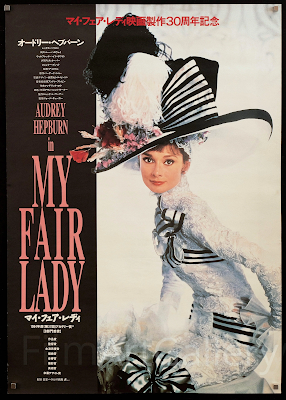
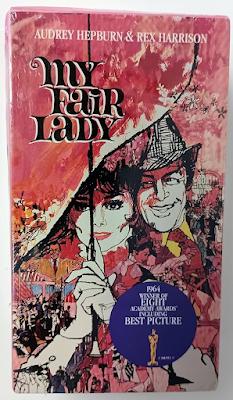
My Fair Lady (1964)
Pompous phonetics Professor Henry Higgins is so sure of his abilities that he takes it upon himself to transform a Cockney working-class girl into someone who can pass for a cultured member of high society. His subject turns out to be the lovely Eliza Doolittle, who agrees to speech lessons to improve her job prospects. Higgins and Eliza clash, then form an unlikely bond, one that is threatened by aristocratic suitor Freddy Eynsford-Hill.
This American musical comedy-drama was adapted from the 1956 Lerner and Loewe stage musical based on George Bernard Shaw's 1913 stage play Pygmalion. With a screenplay by Alan Jay Lerner and directed by George Cukor, it stars Audrey Hepburn as Eliza Doolittle (replacing Julie Andrews from the stage musical) and Rex Harrison as Henry Higgins (reprising his role from the stage musical) with Stanley Holloway, Gladys Cooper and Wilfrid Hyde-White.
CBS head William S. Paley made an arrangement where CBS would finance the original Broadway production in exchange for the rights to the cast album (through Columbia Records). Warner Bros. then purchased the film rights from CBS in February 1962 for the then-unprecedented sum of $5.5 million plus 47¼% of the gross over $20 million. Paley added a condition to the Warner contract that ownership of the film negative would revert to CBS seven years following release.
Jack L. Warner wasn't keen on the idea of Rex Harrison reprising his stage role. Peter O'Toole, Cary Grant, Noël Coward, Rock Hudson, Michael Redgrave, and George Sanders were all under consideration for the role.Warner wanted Cary Grant. He was also in negotiations with Peter O'Toole, extremely hot after his Lawrence of Arabia (1962) success, but O'Toole's agents were looking for $400,000, while Harrison was only asking for $200,000.
When asked why he turned down the role of Professor Henry Higgins, Cary Grant remarked that his original manner of speaking was much closer to Eliza Doolittle's. He also told producer Jack L. Warner that not only would he not play Professor Henry Higgins, but if Rex Harrison was not cast in the role, he wouldn't even go see the movie.
After screening the rough cut, producer Jack L. Warner, who had not wanted to cast Rex Harrison, rose in silence, turned to the actor, and bowed.
James Cagney was originally offered the role of Alfred P. Doolittle. When he pulled out at the last minute, it went to the man who played it on Broadway, Stanley Holloway.
Audrey Hepburn was guaranteed $1 Million. She revealed many years later that had she turned down the role of Eliza, the next actress to be offered it would not have been Julie Andrews, but Elizabeth Taylor, who wanted it desperately. Jack L. Warner's was also considering Shirley Jones. Meanwhile, Shirley MacLaine and Connie Stevens were both campaigning for the role.
Audrey Hepburn believed that Julie Andrews should have played Eliza Doolittle in this movie. Andrews said that she "threw a few tantrums" when she learned that she wouldn't be playing Eliza in this movie, and yet she got along very well with Hepburn without holding a grudge against her as she knew Hepburn was an innocent party in the whole thing. Andrews would instead appear in Walt Disney's Mary Poppins that same year, for which she won the Oscar for Best Actress for her role as the titular character. The controversy over Hepburn being cast over Andrews went as far as journalists claiming there was a feud between the two actresses. This, of course, was untrue, as Hepburn and Andrews were friends in real life and had great respect for one another.
Audrey Hepburn had signed for the movie with the understanding that she would do her own singing. She arrived in Hollywood six weeks before shooting began to work with a vocal coach and musical director André Previn and actually recorded her tracks for the musical numbers. When Hepburn was first informed that her voice wasn't strong enough and that she would have to be dubbed, she walked out. She returned the next day and, in a typically graceful Hepburn gesture, apologized to everybody for her "wicked behavior." Hepburn later admitted she would never have accepted the role of Eliza Doolittle if she had known that producer Jack L. Warner intended to have nearly all of her singing dubbed. After making this movie, Hepburn resolved not to appear in another movie musical unless she could do the singing on her own.
Most of Audrey Hepburn's singing was dubbed by Marni Nixon (but not all). This was primarily due to the songs not being transposed down to a key appropriate for Hepburn's voice. Hepburn sang most of Just You Wait, as well as the reprise to the song, showcasing her ability to sing perfectly at ease when the songs were set in a reasonable key.
Hepburn was not the only one dubbed. Jeremy Brett was very surprised to learn that all of his singing was to be dubbed by a 43-year-old American named Bill Shirley, especially since his own singing voice at that time was remarkably good. Apparently it was because he was a baritone and they wanted a tenor.
Audrey Hepburn announced the assassination of John F. Kennedy to the devastated cast and crew on November 22, 1963, immediately after filming Wouldn't It Be Loverly? on the Covent Garden set.
At Audrey Hepburn's insistence, director George Cukor shot all of her scenes in sequence so that she could grow into the role and hold her own against Rex Harrison and Stanley Holloway, who had both done the play for several years. It also allowed her to do the most difficult scenes first, those before Eliza's transformation, while she was still fresh. The shoot was unusually exhausting for Audrey Hepburn, who lost eight pounds during filming. Her work was intensified by domestic problems with husband Mel Ferrer, who was playing a supporting role in Sex and the Single Girl (1964) on the Warner Brothers' lot. Things became so bad that Cukor had to shoot around her for a week so she could get her health back.
Audrey Hepburn's failure to win an Oscar nomination was considered a major upset, triggering protests from Warner Brothers and director George Cukor. She rose above the snub, however, when the Academy invited her to present the Best Actor award, which went to co-star Sir Rex Harrison.
Rex Harrison was very disappointed when Audrey Hepburn was cast as Eliza Doolittle, as he felt she was badly miscast, and he had hoped to work with Julie Andrews. He told an interviewer, "Eliza Doolittle is supposed to be ill at ease in European ballrooms. Bloody Audrey has never spent a day in her life out of European ballrooms." Nevertheless, Harrison was once later asked to identify his favorite leading lady. Without hesitation, he replied, "Audrey Hepburn in My Fair Lady (1964)." However, it was widely believed he made this remark because he knew her fans wanted him to say that.
The song I've Grown Accustomed to Her Face held special memories for the actor, as during the original Broadway run he used to sing the song to his third wife Kay Kendall, who would stand in the wings watching his performance. Harrison later admitted that when he sang the song in this movie, he was thinking all the time about Kendall, who had died a few years before from leukemia. When Harrison accepted his Academy Award for this movie, he dedicated it to his "two fair ladies," Audrey Hepburn and Julie Andrews.
Despite extensive vocal training after landing the part of Professor Henry Higgins in this movie, Rex Harrison was unable to sing a note. In the end, director George Cukor gave up and told him to quasi-speak the whole thing as he had done in the stage version. Because of the way Harrison talked his way through the musical numbers, they were unable to pre-record them and have him lip-sync, so a wireless microphone (one of the first ever developed) was rigged up and hidden under his tie. However, this meant that his mouth and words were completely in sync and everyone else's looked off, since they were lip-synching (when everyone is lip-synching, it's not that noticeable). The studio thought that this was too obvious so they altered Harrison's soundtrack, lengthening and shortening notes in various places so that his synchronicity is slightly off like all of the other actors and actresses.
Joshua Logan wrote in his autobiography that he was offered the chance to direct this movie, but the offer was withdrawn when he suggested that some scenes be shot on-location in London. The original choice to direct this movie was Vincente Minnelli, but when his salary demands were too high, the job went to George Cukor.
Director George Cukor and costume/production designer Cecil Beaton, who were good friends beforehand, had a big falling-out during the production. Cukor complained that Beaton tried to take credit for other people's work. He also resented the fact that Beaton's presence prevented him from hiring his usual color consultant, photographer George Hoyningen-Huene. For his part, Beaton considered Cukor vulgar and resented his domineering character. Some observers suggested that the closeted Cukor was put off by Beaton's more flamboyant homosexuality. There were even rumors that Beaton had once stolen a man from Cukor.
Cukor and Beaton's biggest on-set argument was over Beaton's assignment to photograph the cast. Cukor felt that his photography was slowing down production and told him to stop taking shots on the set. Then he complained that posing for the portraits was overworking the actors and actresses. Yet Beaton persisted in taking pictures. After some on-set blow-ups, Cukor complained to Warner Brothers, and Beaton stopped coming to the set. Beaton also had a habit of setting up his art easel to sketch and paint the sets while filming was in progress. Producer Warner and Cukor had Beaton banned from the daily filming stage, as well as from any Warner Brothers stage on which set construction, painting, set green, and set decorating was in progress.
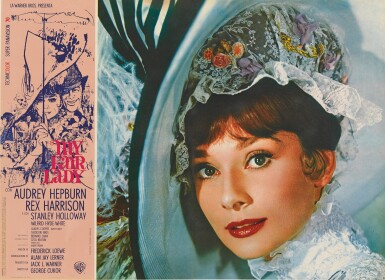
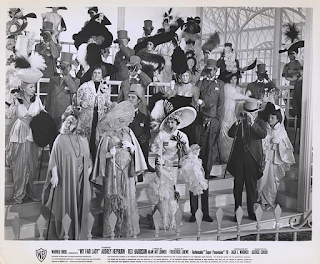
Costume designer Cecil Beaton created 1,500 costumes for this movie, with the exception of the pearl white gown Hepburn wears to the Embassy Ball, an original Edwardian specimen Beaton found in an antique shop. When Hepburn entered the set for the first time in Eliza's gown for the ball, she was so beautiful the crew and the rest of the cast stood silently gaping at her, then broke out with applause and cheers. For the early part of Eliza's transformation, Beaton insisted that Hepburn wear weights around her lower legs so that she would keep some of the flower girl's early gawkiness. Most costumers and make-up artists had to camouflage Hepburn's square jaw, but for her early scenes, production designer Beaton actually emphasized it by putting her in a straw hat. That allowed for a more dramatic transformation, accentuated by the upswept hairdos he designed for her later in the movie to show off her bone structure. All hats were created by Parisian milliner Madame Paulette at Beaton's request.
Cukor and Cecil Beaton took a lavish approach to this movie's set design. In a departure from standard Hollywood practice, rather than building cobblestones for the Covent Garden streets from a single mold, they had each stone made individually. Art director Gene Allen, a frequent Cukor collaborator, used several coats of paint on the buildings to create the illusion that they were hundreds of years old. Production designer Gene Allen went on record to say that Beaton only designed the women's clothes and had no part in the actual designs of the sets, though he insisted on taking the credit for them. In fact, Beaton had it written into his contract that he receive sole credit for production designer. Allen was never given a budget with which to work. He just designed and had built all of the sets without having to worry about how much they cost. When director George Cukor asked to do expensive retakes of the Ascot sequence, Warner Brothers refused. When Cukor persisted, the company had the set torn down. At $17 million, this was the most expensive Warner Brothers movie produced at the time. Nevertheless, it went on to become one of the biggest grossing movies of 1964.
A critical and commercial success, it became the second highest-grossing film of 1964.Nominated for twelve, it won eight Academy Awards, including Best Picture, Best Director and Best Actor.