Followers

Total Pageviews

Showing posts sorted by date for query I Don't Wanna Go. Sort by relevance Show all posts

Sunday, May 03, 2026

Wonderland Burlesque's Down The Rabbit Hole: Vengaboys

Wonderland Burlesque's
Down The Rabbit Hole:
Vengaboys

Down The Rabbit Hole merely places a spotlight on something slightly unusual that's caught my interest. With the help of Wikipedia, YouTube, and other sites, I gather information and learn something new.

Today, we take a look at the music and history of Vengaboys.

--- ---

From Wikipedia:

Vengaboys is a Dutch Eurodance music group based in Rotterdam consisting of lead and female vocalist Kim Sasabone, female vocalist Denise van Rijswijk and male vocalists Robin Pors and Donny Latupeirissa. Created by Dutch producers Wessel van Diepen (who selected the group members) and Dennis van den Driesschen (known as Danski and Delmundo), the group enjoyed commercial success in the late 1990s. They are best known for their hit singles We Like to Party, Boom, Boom, Boom, Boom!! and We're Going to Ibiza, the latter two of which topped the UK Singles Chart and have sold an estimated 25 million records worldwide.

On May 2, 2000, the World Music Awards gave Vengaboys the award for best-selling dance group of the year. The name 'Vengaboys' was originally the title of the electronic musical project of Dutch producers Danski and Delmundo as DJs in the early 90's. In 1997 they decided to use the name to produce a pop group, choosing the Brazilian-Dutch singer Kim Sasabone as the vocal lead. After some auditions, Denise Post-Van Rijswijk, Roy den Burger and Robin Pors were added to complete the group.

In August of 1997, the group released their debut single, followed by two more singles in December 1997 and February 1998. In April of 1998, the group released their debut album Up & Down - The Party Album in the Netherlands and Belgium. The album was certified gold in the Netherlands. This was followed by We Like to Party! in May, which peaked at #2 on the Dutch charts and at #1 in Belgium in June of 1998.

In October the group released Boom, Boom, Boom, Boom!! and Greatest Hits! Part 1, the album peaked at #1 on the Dutch chart.

In November of 1998, the Vengaboys entered the UK Singles Chart at #4 with Up and Down. We Like to Party! was released internationally in 1999 and was a Top 10 hit in many European countries, Canada, Australia, and New Zealand. It reached #26 on the Billboard Hot 100.

In June 1999, The Vengaboys re-released Greatest Hits! Part 1 as The Party Album. The single Boom Boom Boom Boom!! went to #1 in the UK, New Zealand and the Netherlands. The album would spent 30 consecutive weeks on the US Billboard 200, and was certified gold. 

We're Going to Ibiza, a reworking of Typically Tropical's 1975 #1 hit Barbados, also reached the top slot in the Netherlands in September 1999. A remix album followed.

The Platinum Album was released in early 2000. Its first three singles Kiss (When the Sun Don't Shine), Shalala Lala and Uncle John from Jamaica all charted in Europe, Australia and New Zealand, and Canada, with the first two going on to top the New Zealand charts. Prior to the album's release, Pors left the group to pursue a solo career and was replaced by dolphin trainer Yorick Bakker.

In 2002 Post-Van Rijswijk and Bakker left the group, effectively shuttering the group.

They would return in 2007, with Bakker leaving, again, in 2009.

In 2010, the band released a new single, Rocket To Uranus, a collaboration with singer-songwriter Pete Burns and American celebrity Perez Hilton. An additional single and a holiday album followed. The single Where Did My X-mas Tree Go was released together with a new music video.

The group continues to tour and released a single, 1999 (I Wanna Go Back) in September of 2021.

 
We Like To Part - Vengaboys

Boom, Boom, Boom - Vengaboys

We're Going To Ibiza - Vengaboys

Rocket To Uranus - Vengaboys


--- ---

Sunday, March 02, 2025

Wonderland Burlesque's Down The Rabbit Hole: Italo-Disco

Wonderland Burlesque's
Down The Rabbit Hole:
Italo-Disco

Down The Rabbit Hole merely places a spotlight on something slightly unusual that's caught my interest. With the help of Wikipedia, YouTube, and other sites, I gather information and learn something new.

Today, we take a look at Italo-Disco.

--- ---

Talk about your guilty pleasures!

This genre first came to my attention while researching Twenty One's The Eyes Of Don Johnson. To learn more? I didn't have to go very far. 

In fact, I believe that Angelica Frey at Discogs has probably written the master class on this genre. So, because I'm lazy, I'll let her do all the heavy-lifting. Why mess with perfection?

Here's Frey and Giuseppe Savoni's list of the essential cuts which define this genre. To read her insightful track-by-track description, head to Discogs.

From Angelica Frey:

"Italo-Disco is a genre that thrived between the late 1970s and mid-1980s and comes back in style about every five years. With its sugary choruses and glittering instrumentals, it’s not hard to hear why. The name, coined by German discographer Bernhard Mikulski, the owner of ZYX label, describes the disco-inflected records from the namesake region at the time.

While quite heterogeneous, Italo-Disco combines synths, 4/4, the Philly, and the Munich sounds and favors simple, straightforward melodies. It’s also extraordinarily prolific. Labels like Disco Magic had an assembly-line approach. And often times, the de-facto leader of an act was not necessarily the person providing vocals.

Italo-Disco’s influence reverberated internationally. Eiffel 65‘s Blue would not exist without it, nor would Eurodance and its child-friendly varieties seen in the 1990s. Japan’s own interpretation of Eurobeat also owes a debt to Italo-Disco.

While gathering the essential singles, Discogs consulted music curator, DJ, and scholar Giuseppe 'Disco Bambino' Savoni. Consider these ten tracks a window into the genre that may never disappear into the history books."

Remember - Vivian Vee
1979

I Wanna Be Your Lover - La Bionda
1980

I Like Chopin - Gazebo
1983

Spacer Woman - Charli
1983

Hypnotic Tango - My Mine
1983

Magic Carillon - Rose
1984

Self Control - Raf
1984

Only Music Survives - Alba
1985

Tarzan Boy - Baltimora
1985

Call Me - Spagna
1987

--- ---
Have a favorite of the genre not listed? 

Leave it in the comments section. 

Me? I never wanted this list to end.

Thanks for reading.

And check out Discogs.and Angelica Frey's full article.

Wednesday, October 16, 2024

Wonderland Burlesque's As The Diva Turns! - Ariana, Victoria, and Lady G

Wonderland Burlesque's
As The Diva Turns!
Ariana, Victoria, and Lady G

Spotlighting some recent diva turns on the part of three of our faves.

I must say, you are in for quite the treat. 

Up first? Ariana Grande sliding notes all over a classic R&B groove with Don't Wanna Break Up Again.

Then we have the lovely Victoria Monét borrowing a bit from Michael J. as she floats back to the divine 1900s.

And finally, Lady Gaga in a dramatic turn with the heartbreaking Happy Mistake.

All in all, a magnificent week for diva turns.

Yes, the show must go on!

Midweek hump?
Feeling in the dumps?
Here's some music to make your heart jump!
- uptonking from Wonderland Burlesque
 
Don't Wanna Break Up Again - Ariana Grande

1900s - Victoria Monét

Happy Mistake - Lady Gaga


--- ---

Thursday, July 18, 2024

Wonderland Burlesque's Let's All Go To The Movies: Broadway Melody Edition


Wonderland Burlesque's Let's All Go To The Movies: 
Broadway Melody Edition

I simply couldn't let our time on Broadway end without paying tribute to this wonderful series of films. 

Yes, show biz folk, in all their glory; the grit, the glam, the flim, the flam... they wouldn't have it any other way. 

It's all for that big opening night and the sound of applause.

So, raise the curtain, light the lights... it's time for a sweet Broadway Melody!

--- ---

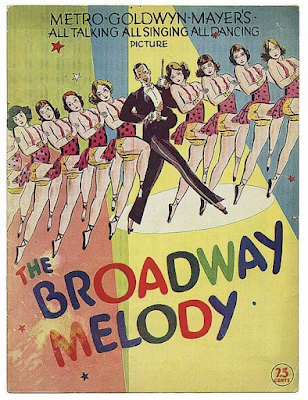
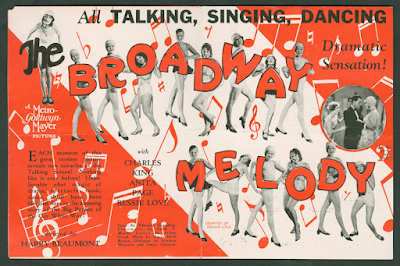
The Broadway Melody
(1929)
AKA: The Broadway Melody of 1929

Hank and Queenie Mahoney, a vaudeville act, come to Broadway, where their friend Eddie Kerns needs them for his number in one of Francis Zanfield's shows. Eddie was in love with Hank, but when he meets Queenie, he falls in love to her, but she is courted by Jock Warriner, a member of the New Yorker high society. It takes a while until Queenie recognizes that she is, for Jock, nothing more than a toy. It also takes a while for Hank to recognize that Eddie is in love with Queenie.


This American pre-Code musical was the first sound film to win an Academy Award for Best Picture. It was also one of the earliest musicals to feature a Technicolor sequence, which sparked the trend of color being used in a flurry of similar musicals which would hit the screens from 1929 through 1930. Today, the Technicolor sequence survives only in black and white. The film was the first musical released by Metro-Goldwyn-Mayer and was Hollywood's first all-talking musical.


Written by Norman Houston and James Gleason from a story by Edmund Goulding, this film was directed by Harry Beaumont and stars Bessie Love, Charles King and Anita Page. It features original songs written by Arthur Freed and Nacio Herb Brown, including the popular hit You Were Meant for Me. Bessie Love was nominated for an Academy Award for Best Actress for her performance.


Because this movie was one of the early sound features made, the production team learned how to record sound properly by trial-and-error. After the rushes were seen, the sets were changed to improve recording quality and scenes were re-shot, resulting in long days for the actors and an overall long shooting schedule. For example, it took over three hours to film Bessie Love's brief ukulele-playing scene. For earlier takes, a full orchestra was off-camera, but for later takes, the actors sang and danced to prerecorded music. A silent version of the film was also produced, as there were still many motion picture theaters without sound equipment at the time.


The film featured a musical sequence for The Wedding of the Painted Doll which was presented in early two-color Technicolor (red and green filters). Color quickly became associated with the musical genre, and numerous features were released in 1929 and 1930 that either featured color sequences or were filmed entirely in color. Movies like On with the Show (1929), Gold Diggers of Broadway (1929), Sally (1929), The Life of the Party (1930), among others, all featured color footage.


This film was a huge success and made a profit of $1.6 million for MGM.  It was the top grossing picture of 1929 and won the Academy Award for Best Picture at the 2nd Academy Awards. In addition, Harry Beaumont received a nomination for Best Director, and Bessie Love was nominated for Best Actress. 


\


--- ---

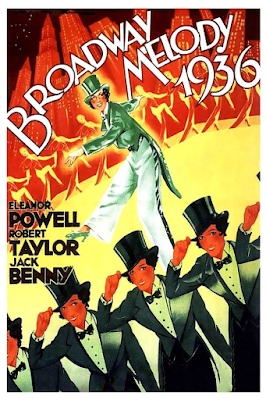
Broadway Melody of 1936
(1935)

Bob Gordon is staging a new Broadway show, but he is short of money. He gets a funding offer from a young widow named Lillian - but only if she can dance in his new show. Bert Keeler, a newspaper man, gets ahold of this information and writes about this in his column throwing considerable shade. Meanwhile, Gordon's old class mate Irene Forster, a tap dancer from Albany, learns about the show and auditions to get the leading role - the role Lillian, the show's financial backer, insists is hers. So Irene Forster, Bert Keeler and Gordon's secretary, Kitty, start scheming to get Irene that leading role.


Written by Harry W. Conn, Moss Hart, Jack McGowan and Sid Silvers, this musical was directed by Roy Del Ruth and stars Jack Benny, Eleanor Powell, Robert Taylor, June Knight, Frances Langford, Sid Silvers, Buddy Ebsen and Vilma Ebsen. It was nominated for the Academy Award for Best Picture.


This musical was released by Metro-Goldwyn-Mayer in 1935, as a follow-up of sorts to the successful The Broadway Melody (1929), although, there is no story connection with the earlier film beyond the title and some music.


Originally scheduled to be completed in four weeks, the picture ended up taking four months to complete.


Eleanor Powell was spotted in a Fox screen test by MGM studio chief Louis B. Mayer, who, due to the grainy quality of the test, initially thought she was African-American. Once Fox cast her in George White's Scandals (1934), MGM made its move. Reportedly, Powell did not want to participate in this film, as she was slated for the non-dancing role eventually played by Una Merkel. Too much of a neophyte to confront the studio executives, she engineered her dismissal by politely demanding the lead role and an exorbitant salary. Imagine her surprise when the studio met her terms, paving the way for her meteoric film career. Her singing was dubbed by Marjorie Lane, as it would be for the remainder of Powell's movie career.


The success of  Powell's dance routines relied heavily upon production values, as Powell choreographed her own numbers, all of which were nearly identical. It was the costuming and lavish set creations which provided variety and prevented audiences and critics from taking note of the fact that they were highly repetitive.


This was the film debut of Buddy Ebsen. Buddy and Vilma Ebsen had appeared together as a brother-and-sister act in vaudeville. This film marked their film debut. However, Vilma retired soon after to marry musical director Robert Emmett Dolan, leaving Buddy to stay on at MGM, and eventually make his mark in television as the iconic star of two long-running series, The Beverly Hillbillies and Barnaby Jones.


The film was nominated for three Oscars at the 8th Academy Awards: Best Picture, Best Writing (Original Story), and Best Dance Direction, winning the last one.


--- ---

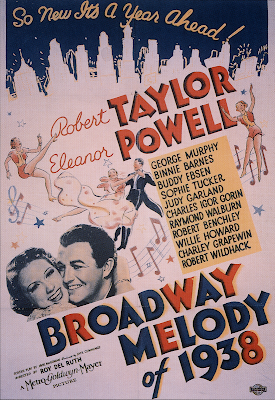
Broadway Melody of 1938
(1937)

Steve Raleigh wants to produce a show on Broadway. He finds a backer, Herman Whipple and a leading lady, Sally Lee, however his financial backer's wife, Caroline Whipple, forces Steve to use a known star, not a newcomer. Sally purchases a horse she used to train when her parents had a farm before the depression and with two ex-vaudevillians, Sonny Ledford and Peter Trott, she trains it to win a race, providing the money Steve needs for his show.


This American musical film was produced by Metro-Goldwyn-Mayer and directed by Roy Del Ruth. Essentially a backstage musical revue, featuring high-budget sets and cinematography in the MGM musical tradition, the film stars Eleanor Powell and Robert Taylor and features Buddy Ebsen, George Murphy, Judy Garland, Sophie Tucker, Raymond Walburn, Robert Benchley and Binnie Barnes.


The film is most notable for young Garland's performance of You Made Me Love You (I Didn't Want to Do It), a tribute to Clark Gable which turned the teenage singer, who had been toiling in obscurity for a couple of years, into an overnight sensation. It would eventually lead to her being cast in The Wizard of Oz (1939) as Dorothy. Coincidentally, co-star Buddy Ebsen was also cast as the original Tin Man in The Wizard Of Oz, but had to be replaced when he became too ill to perform due to the toxic silver paint they used to create the 'tin' effect. However, Charley Grapewin, who portrays the horse trainer in this film (though he shares no scenes with Garland), achieved screen immortality playing Garland's Uncle Henry (husband of Auntie Em) in The Wizard of Oz (1939). 


The song Dear Mr. Gable was a birthday present for Clark Gable's 36th birthday. Composer and arranger Roger Edens adapted the old song You Made Me Love You by James V. Monaco. It was sung at Gable's studio birthday party by a young Judy Garland. Studio head Louis B. Mayer was so impressed by it, that he gave orders to let Garland sing it again in the next great musical MGM was going to produce. He also immediately cast her in two MGM films.


Judy Garland and Sophie Tucker

--- ---

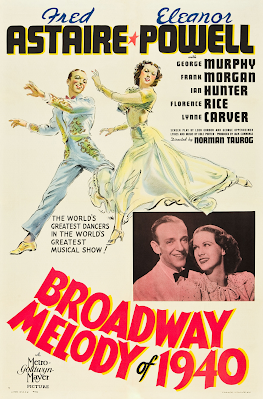
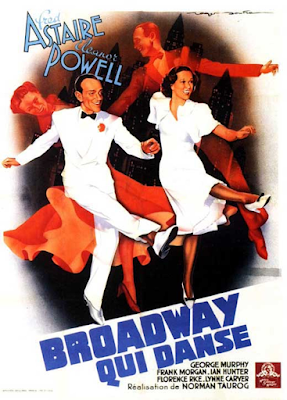
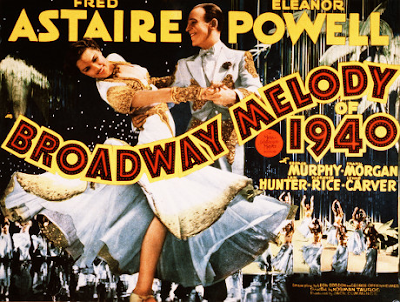
Broadway Melody of 1940

Johnny Brett and King Shaw are a dance team so down on their luck that they work in a dance hall for no money. Meanwhile, Clare Bennett is a big Broadway star. Owing to a case of mistaken identity, Shaw is offered the chance to be Clare's dancing partner in a new Broadway show, when Johnny's dancing was really what producer Bob Casey saw and wanted. The partnership breaks up, but Johnny still helps out King, who lets his newfound success go to his head. Clare eventually realizes that Johnny, not King, is the better dancer, and she falls in love with him after the two have lunch. When Shaw gets drunk on opening night, Johnny steps in and saves the show with a brilliant performance, though he lets King think he did it himself. Clare later tells King the truth. Just before the next show, Clare discovers King drunk again, and Johnny becomes the permanent replacement. After the show, they find out that King was pretending to be drunk so that Johnny would get the job.


Based on a story by Jack McGowan and Dore Schary, this MGM musical was directed by Norman Taurog and stars Fred Astaire, Eleanor Powell and George Murphy (Astaire's first male dancing partner on film). It features music by Cole Porter, including Begin the Beguine.


Fred Astaire had just left RKO, and this was his first film for MGM since his small part in 1933's Dancing Lady. Astaire was reportedly slightly intimidated by Powell, as she was considered one of the few female dancers capable of out-performing him. According to Powell in her introduction to the book, The MGM Story, the feeling was somewhat mutual. Powell recalled finally saying to Astaire, "Look, we can't go on like this. I'm Ellie; you're Fred. We're just two hoofers," after which, they got along well, and rehearsed so much they wore out their pianist.


Early in this film, the producer expresses his love for his Broadway star, played by Eleanor Powell, to which she replies how marriage would force her to leave his next show. Coming to his senses, the producer yells, "You can't leave the show, we have a contract!" In real life Eleanor Powell did, in fact, leave show business at the height of her stardom. A a few years after this film, she married Glenn Ford and retired from the screen. She would return only after they divorced some 15 years later.


A fifth Broadway Melody film was planned for release in the early 1940s, pairing Eleanor Powell with Gene Kelly, but production was cancelled at the rehearsal stage. Another film in the series was planned, Broadway Melody of 1943 starring Eleanor Powell and Gene Kelly. However, that project was abandoned because Kelly was borrowed out to do a film with Rita Hayworth. Several musical numbers had been completed, including a dance number filmed by Eleanor Powell  which was later edited into Thousands Cheer (1943).  Another production was to have been called Broadway Melody of 1944.  but was instead renamed Broadway Rhythm. It starred Louis B. Mayer's mistress, Ginny Simms and included several numbers by Lena Horne which had been filmed for the abandoned Gene Kelly/Eleanor Powell film. 


Tis film was in production from early September until late November 1939. The set for the Begin the Beguine number cost $120,000 to construct and utilized a sixty-foot multi-paneled mirror mounted on a revolving track to change backgrounds.


Follows The Broadway Melody (1929), Broadway Melody of 1936 (1935) and Broadway Melody of 1938 (1937). The 1940 entry is considered Powell's last major successful film, as she would go on to appear in a succession of only moderate hits before retiring from the screen several years later.


--- ---

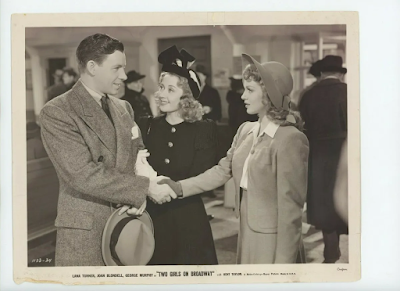
Two Girls On Broadway
1940

Eddie sells his song to a Broadway producer and lands a job dancing in the musical. He sends for his dance partner-fiancée Molly, who brings her younger sister Pat. Upon seeing Molly and Pat dance, the producer picks Pat for the show and gives Molly a job selling cigarettes. A wealthy friend of the producer named Chad also has is eye on Pat. Pat is teamed with Eddie in the specialty number as Kerns and Mahoney. Pat and Eddie soon realize that they are in love and must tell Molly. Pat balks at hurting Molly and goes out with Chad instead, even though she knows he already has five ex-wives!

This musical was directed by S. Sylvan Simon and stars Lana Turner,  Joan Blondell and George Murphy.


This film is a remake of The Broadway Melody (1929), starring Bessie Love and Anita Page as the Mahoney sisters and Charlie King as Eddie. This film is the earliest remake of a Best Picture Oscar winner.


This was made at the point in Lana Turner's career when she was still being groomed for stardom by M-G-M, and they hadn't yet finalized her 'look'. In this film (and all of her preceding ones) Turner appeared as a 'dish water blonde', but two films later, for Ziegfeld Girl, the studio hairdressing department lightened her hair to platinum blonde, similar to the look of one of their biggest stars of the 1930s, Jean Harlow - and suddenly, Turner rose to stardom. By the time of production, Lana Turner was hailed 'The Girl They're All Talking About! Lovely Lana, America's Blonde Bonfire, in her hottest, most daring role!' Being in the middle of a highly publicized career, Turner was in the position to demand top-billing, even though she was less experienced than both her co-stars.


Blondell had been a favorite on the Warner Bros. lot because she took whatever was offered her, gave it her all, and never complained. This film was her first for MGM. At one point, Blondell asks the children in the film, "You all wanna be Fred Astaire and Eleanor Powell someday, don't you?" This was a not-so-subtle plug for Broadway Melody of 1940, which had opened just a few weeks earlier and was still playing around the country


The part of the rotund radio host who introduces George Murphy's song-and-dance routine is played by America's best known announcer at the time, Don Wilson, who spent decades as Jack Benny's straight man and sidekick.


The film received mixed reviews, with most critics complaining about the plot playing second fiddle to showcasing Turner. A New York Times critic wrote: "With Lana Turner figuring prominently in the doings, it is fairly safe to predict that none of the patrons will bother to inquire where and when they have seen Two Girls on Broadway before. There is an indefinable something about Miss Turner that makes it a matter of small concern."


This film was barely successful at the box office, earning MGM a profit of only $12,000 according to studio records.


Lana Turner, George Murphy, and Joan Blondell

--- ---

And that's all for now.

Tune in next time...

Same place, same channel!

--- ---

Dear Mr. Gable - Judy Garland
from the 1937 motion picture Broadway Melody of 1938